Strategic commitments rarely collapse from lack of operational effort. They fail because the load-bearing assumptions underneath them were never independently pressure-tested before the capital was released.
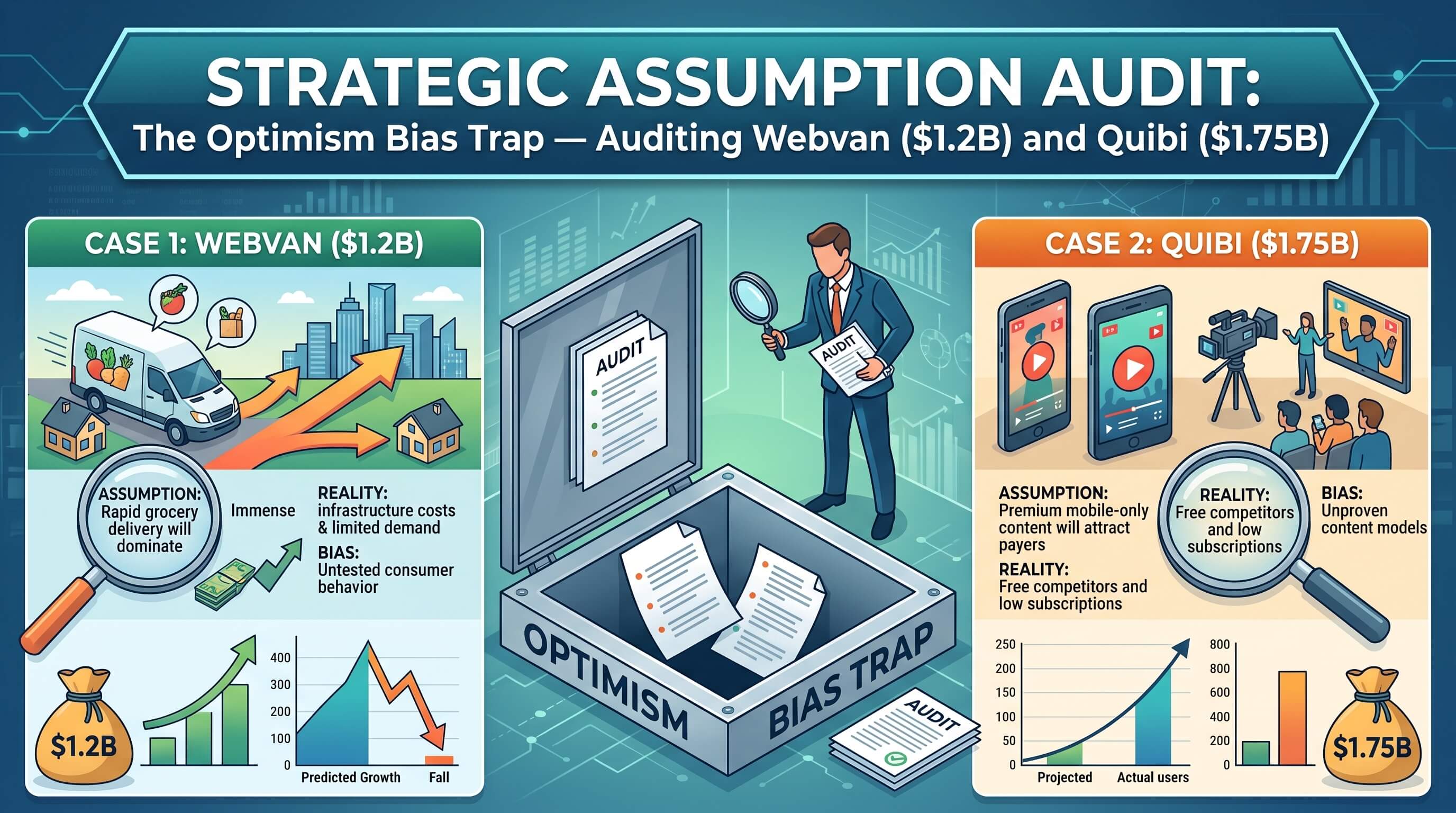
“The Optimism Bias Trap: Assessing Webvan ($1.2B) and Quibi ($1.75B) — Why internal model coherence collapses without verified market behavioral demand.”
Strategic Decision Assessment
The Three Load-Bearing Vulnerabilities Behind Billion-Dollar Strategic Collapses
Strategic commitments rarely collapse from lack of operational effort. They fail because load-bearing assumptions were never independently stress-tested against market terrain before capital deployment:
- 01 Internal Coherence vs. Physical Terrain: A business model can be mathematically harmonious on paper while depending on unvalidated consumer behavior shifts that fail upon initial real-world friction.
- 02 The Scale Trap Before Validation: Webvan burned $1.2B building automated infrastructure before proving unit economic contribution margin; Quibi committed $1.75B to proprietary production without validating subscriber willingness to pay.
- 03 Independent Pre-Commitment Scrutiny: Capital allocation decisions must separate management consensus from falsifiable evidence, establishing observable kill signals before irreversible resources are expended.
In November 1999, Webvan completed its initial public offering, briefly commanding an $8.5 billion valuation on less than $5 million in cumulative revenue alongside $50 million in accumulated deficits. Backed by over $800 million from tier-one venture syndicates, its thesis promised automated 30-minute grocery delivery windows.
Within twenty-four months, Webvan exhausted $1.2 billion in cash reserves and entered bankruptcy. The failure was not one of vision or ambition; it was a failure to audit load-bearing assumptions regarding customer drop density, fulfillment logistics complexity, and unit contribution margins before scaling physical infrastructure.
In April 2020, Quibi launched capitalized with $1.75 billion. It held premier Hollywood production contracts, institutional governance, and high-visibility marketing reach. The central thesis presumed mobile users would pay subscriptions for ten-minute premium serialized content during transient commutes.
External terrain shifted. Lockdowns disrupted commuting routines, while open platforms including TikTok and YouTube captured ambient attention with zero subscriber friction. Quibi ceased operations six months post-launch. The initiative possessed immense resources, yet lacked verified behavioral demand prior to capital deployment.
Two Decades Apart. One Structural Failure Pattern.
Data from the U.S. Bureau of Labor Statistics indicates that among private-sector enterprises established in 2013, only 34.7% sustained operations through 2023. Corporate decline is seldom an overnight catastrophe; it compounds through incremental commitments whose underlying hypotheses were never independently audited.
Across more than two decades evaluating business decisions across consulting, investing, and operational ventures, the diagnostic reality remains constant: execution bottlenecks almost invariably trace back to flawed pre-commitment reasoning.
The structural vulnerability recurs across three predictable vectors:
- Compounded Financial Optimism: Spreadsheets that balance through aggressive terminal multiples while concealing fragile unit cash conversion.
- Theoretical vs. Operational Capacity: Strategic plans that confuse what a company can model with what its organizational architecture can execute under market stress.
- Unobserved Coordination Friction: Leadership teams that underestimate the cognitive overhead and structural friction required to pivot capital.
Strategic failure is rarely an execution problem. It is almost always a misread of the terrain — where foundational assumptions were never subjected to structured, adversarial scrutiny before the commitment became irreversible.
Stratimind Advisory · Decision Assurance Practice
The Purpose of Independent Assessment
Stratimind was built specifically to address this pre-commitment vulnerability. It is an independent strategic decision assessment service designed to surface, interrogate, and stress-test the core assumptions inside consequential choices before capital and organizational energy become irreversible sunk costs.
The methodology operates across three structural priorities:
1. Surfacing Hidden Assumptions: Explicitly isolating baseline hypotheses regarding market depth, unit margins, and distribution density from executive advocacy.
2. Establishing Observable Kill Signals: Defining explicit, falsifiable metrics at each stage-gate to distinguish whether to proceed, recalibrate, or halt commitment.
3. Providing Institutional Decision Rigor: Bringing the forensic scrutiny historically confined to top-tier institutional boards to leaders navigating high-stakes commitments.
INDEPENDENT STRATEGIC ASSESSMENT · DECISION CONDITIONS
Sound business judgment is not an innate intuition. It is an institutional discipline practiced by leaders who examine the structural assumptions of a commitment while alternatives are still available.
Stratimind Advisory · Strategic Decision Assessment Practice