The OEM-to-Brand Pivot: 3 Flawed Assumptions Behind Western Market Entry
Manufacturers often assume that superior product engineering and cost advantage will automatically translate into brand equity. An independent pre-commitment assessment identifies three structural barriers that cannot be solved by marketing spend alone:
- 01 The Social Permission Gap: Brand authority in Europe is not built on engineering parity; it is ambient trust accumulated through decades of distribution ecosystems and institutional endorsement that capital cannot instantly purchase.
- 02 The Post-War Playbook Fallacy: Applying the Japanese historical transition (Sony, Toyota) to modern Chinese manufacturers ignores fundamentally different structural conditions: persistent geopolitical friction and divergent cultural tailwinds.
- 03 Conflating Intent with Legitimacy: Entering with non-extractive, long-term intent does not create local embeddedness; European commercial societies demand explicit alignment with local business fabric and separate diagnostic scrutiny from execution advisory.
I spent the day with the founder and chairman of one of China's most accomplished consumer goods manufacturers. His company has spent over two decades producing for some of the most recognized premium brands sold in Europe and North America.
A few years ago, when critical high-end components were suddenly cut off, they didn't wait. They funded their own R&D, rebuilt the capability in-house, and moved from anonymous supplier to genuine first-tier player by any measurable global standard.
The engineering is exceptional. The scale is real. The institutional knowledge runs deep.
And almost nobody outside the supply chain knows who they are.
Before he left, he asked me something I've been turning over ever since:
"We manufacture what they sell. We understand the product better than the brand does. But in European and North American markets, we still can't escape the OEM label. After all this time, why?"
That question deserves a serious answer. It doesn't have a simple one.
The Japan comparison comes up often in these conversations, and it's worth examining carefully — not as a template, but as a contrast. Sony, Toyota, and Canon all had to work their way out of a "cheap imitation" perception before becoming the global benchmarks we recognize today. That transition happened.
But it was enabled by two structural conditions that don't exist for Chinese manufacturers in the same form today.
Geopolitically, Japan was a close strategic ally of both the United States and key European economies during the Cold War. That context quietly cleared cultural runway that tends to get underestimated in retrospect. And Japanese aesthetics — craft as philosophy, restraint as refinement — were qualities that European and North American consumers actively romanticized. They wanted to buy into the narrative. The story did work that capital alone cannot.
China faces a genuinely different set of conditions: geopolitical headwinds that are structural and not resolving on a short timeline, and a cultural narrative that hasn't been internalized by mainstream consumers in those markets in the same way. The path exists. The terrain is different. Borrowing the Japanese playbook without adjusting for that difference is a common and expensive mistake.
The Mechanism Behind Brand Authority
My second observation challenged a deeply ingrained assumption about market entry. The question he kept returning to "how do you balance brand-building with market development, which one comes first, how do you coordinate the two...", may actually be obscuring the real mechanism at play....
It frames brand and marketing as competing budget lines. But the reason consumers in his target markets trust the brands his factory produces for isn't primarily because those brands outspent competitors. It's because those brands accumulated what I'd call social permission — through distribution relationships, editorial presence, and decades of appearing in the right contexts often enough that trust became ambient, nearly invisible.
That kind of permission cannot be purchased directly. It can be inherited, if you identify partners who already hold it in your target market and structure the relationship with enough precision. That architecture is what most Chinese manufacturers are missing. It is not a marketing problem.
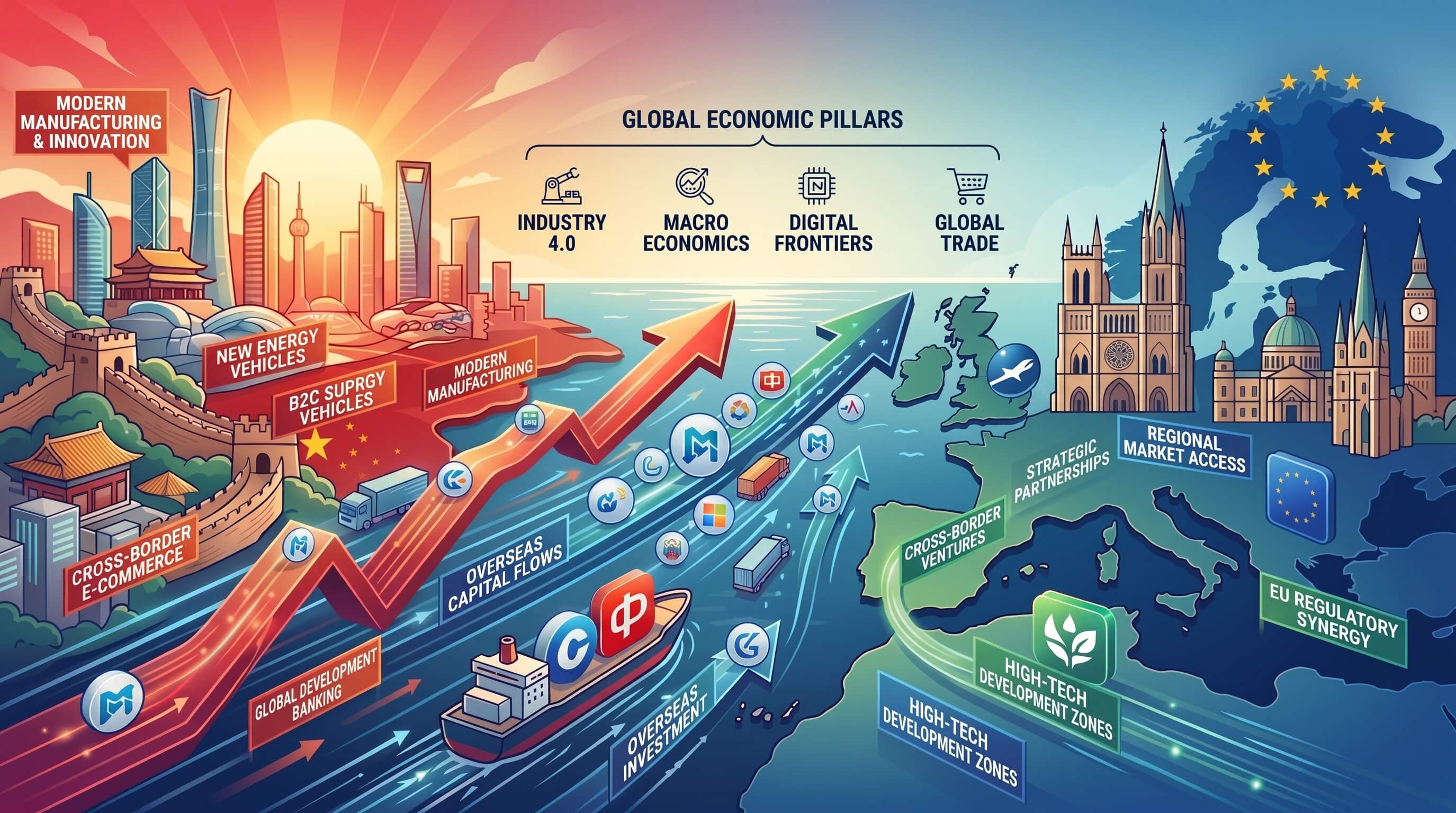
“The Social Permission Gap: Manufacturing capability creates market entry; ambient legitimacy, distribution ecosystems, and local trust create enduring brand authority.”
There's a third dimension that rarely surfaces in formal strategic analysis, and it's probably the most underestimated.
This chairman, like most of the Chinese entrepreneurs I've worked with across more than two decades in cross-border strategy, is not approaching expansion into Europe or North America with aggressive or extractive intent. He started with nothing. He built something exceptional through discipline, sustained endurance, and what I can only describe as a very long tolerance for invisibility.
He wants to grow, yes. But what he actually described wanting is to belong somewhere — to understand what European and North American business society genuinely expects of a company that arrives from elsewhere and asks to become part of the local fabric. What responsible corporate conduct looks like in that context. How to integrate rather than simply land.
- ◈ European and North American investors tend to assume Chinese expansion ambitions are more aggressive than they are.
- ◈ Chinese entrepreneurs tend to assume their counterparts in those markets are more transactional than they are.
- ◈ The Result: Both sides consistently leave value on the table — not because of capability gaps or strategic gaps, but because no one is standing in the middle doing the translation. Not of language. Of intent.
The Real Gap: Diagnosis vs. Execution
This is where the distinction between diagnosis and execution matters most — and where the two are most often confused.
A diagnostic process has to be structurally independent from whoever benefits from its conclusions. That's not procedural nicety. It's what makes the output credible. A tool that has a stake in the treatment it recommends isn't functioning as a diagnostic instrument. It's a sales process with better framing.
That's partly what led me to build Stratimind independently: an AI-assisted professional platform for strategic assessment and pressure-testing, structurally separate from any execution advisory. It is designed to deliver a rigorous strategic diagnostic. We focus on assessing the unseen assumptions and the narrative behind your expansion, illuminating potential blind spots and potential kill signals, so you can refine your approach while the strategic architecture is still flexible.
What happens after the diagnosis is a different focus. It requires genuine depth in the target market — the regulatory terrain, the commercial culture, the mechanics of deal structure, and the ability to translate strategic intent into something that can actually be executed on the ground. That is what Advention does in European cross-border strategy and M&A advisory.
The two operate at different stages of the same decision. The professional boundaries are clear, the functions don't overlap — and in my experience, that structural separation is not a limitation. It is precisely what makes each more useful to the client it serves.
For Chinese manufacturers seeking to build trusted positions in European or North American markets, that separation matters more than it might appear.
Capability creates entry. Legitimacy creates endurance.
The question is no longer whether Chinese manufacturers can compete at the highest level. They already can. The real question is what it will take for European and North American markets to see them not only as producers, but as trusted brands and long-term strategic partners.
For those who have navigated this from either direction: as a Chinese manufacturer entering these markets, or as an investor, a strategic partner, or a corporate client evaluating market entrants from China: what did you find to be true that the standard frameworks didn't predict?